
 Français
 Français
 Afrikaans
 English
 English
 English
 Español
 Italiano
 Nederlands
 Nederlands
 Norsk Nynorsk
 Português
 Português
 Português
 English
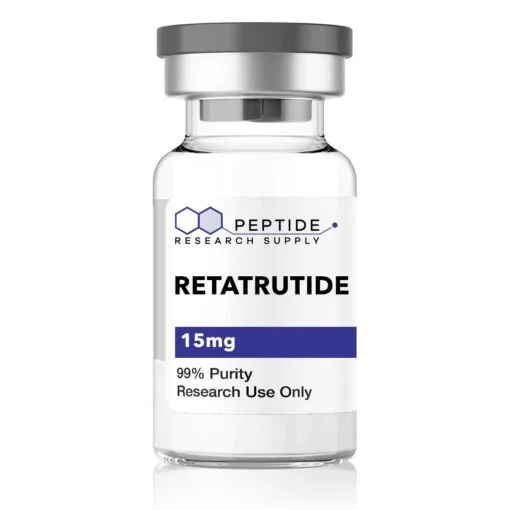
Retatrutide 15mg
Original price was: $150.00.$110.00Current price is: $110.00.
Buy Retatrutide 15mg — the advanced-volume triple-receptor agonist peptide (GLP-1, GIP, Glucagon). ≥99% purity, HPLC-verified, fast shipping to USA, Canada, Germany, France & worldwide. Order now.
Buy Quality Retatrutide 15mg | The World’s Most Demanded Metabolic Research Peptide
In December 2025, Eli Lilly’s TRIUMPH-4 Phase 3 trial dropped a number that stopped researchers in their tracks: 28.7% average body weight lost at 68 weeks. Not a supplement claim. Not an influencer testimonial. A peer-reviewed, multi-thousand-participant clinical trial result — the highest weight loss figure ever recorded for any obesity compound in medical history.
Retatrutide 15mg — the triple GLP-1/GIP/Glucagon receptor agonist — is the compound behind that number. And if you are ready to buy Retatrutide 15mg, you are choosing the vial format specifically built for extended research protocols, multi-phase titration schedules, and researchers who know exactly where their dose is headed.
This is not a beginner vial. This is what serious, sustained research looks like.
What Is Retatrutide 15mg and Who Is It Built For?
Retatrutide 15mg (development code LY3437943) is a synthetic tri-agonist peptide developed by Eli Lilly and Company. Where every peptide in this class before it targeted one or two metabolic receptors, Retatrutide hits three simultaneously — GLP-1, GIP (glucose-dependent insulinotropic polypeptide), and the glucagon receptor. The result is a compound that drives appetite suppression, insulin sensitization, and energy expenditure all at once — three independent metabolic levers pulled in the same direction at the same time.
The 15mg vial format is the practical choice for researchers who have already established their titration tolerance and are moving through escalation phases — or who are planning longer multi-week protocols from the outset. A single Retatrutide 15mg vial covers your entire initiation and early escalation sequence before you even need to open a second vial. That means less frequent ordering, lower per-milligram cost, and fewer reconstitution events — all of which matter when you are running a precise, controlled protocol.
At the 10mg/mL reconstitution concentration, a Retatrutide 15mg vial delivers:
- 15 full weeks at a 1mg weekly dose
- Nearly 8 weeks at a 2mg weekly dose
- Almost 4 full weeks at the 4mg escalation tier
That is your entire initiation phase — handled from one vial, at one lab purchase.
Retatrutide 15mg — Product Specifications
| Feature | Details |
|---|---|
| Active Compound | Retatrutide (LY3437943) |
| Form | Lyophilized powder (white to off-white) |
| Quantity Per Vial | 15mg |
| Purity | ≥99% (HPLC and Mass Spectrometry verified) |
| Receptor Targets | GLP-1, GIP (GIPR), Glucagon (GCGR) |
| Reconstitution | Bacteriostatic water required |
| Storage — Unreconstituted | -20°C up to 24 months; sealed, dry, protected from light |
| Storage — Reconstituted | 2–8°C, up to 28–30 days |
| Testing | Third-party COA per batch |
| Classification | Research peptide — lyophilized format |
| Shipping | USA, Canada, Germany, France, UK, Australia & International |
| Use | Research purposes only |
The Triple-Receptor Mechanism — Why Retatrutide Outperforms Every Competitor
You have heard of Ozempic. You have heard of Mounjaro. Neither of them does what Retatrutide does — and the difference is structural, not incremental.
| Receptor | What It Does | Which Compounds Hit It |
|---|---|---|
| GLP-1 | Suppresses appetite, enhances insulin secretion, slows gastric emptying | Semaglutide, Tirzepatide, Retatrutide |
| GIP | Improves nutrient partitioning, boosts insulin sensitivity, enhances satiety signaling | Tirzepatide, Retatrutide |
| Glucagon | Directly increases energy expenditure, drives fat oxidation, especially visceral and liver fat | Retatrutide only |
That third lever — the glucagon receptor — is the exclusive differentiator. It is why Retatrutide produces weight loss results that semaglutide and tirzepatide simply cannot match. Activating glucagon signaling tells your body to burn fat harder. It raises your metabolic rate. It is the mechanism responsible for the extraordinary liver fat reductions — up to 82.4% in 24 weeks — that no other compound in this class has come close to replicating.
Three receptors. Three simultaneous pathways. One compound.
Retatrutide vs. Semaglutide vs. Tirzepatide — Full Head-to-Head
| Compound | Receptors | Peak Clinical Weight Loss | Liver Fat Reduction | Approval Status |
|---|---|---|---|---|
| Retatrutide (LY3437943) | GLP-1 + GIP + Glucagon | 28.7% at 68 weeks | Up to 82.4% at 24 weeks | Phase 3 (TRIUMPH program) |
| Tirzepatide (Mounjaro/Zepbound) | GLP-1 + GIP | 22.5% at 72 weeks | Moderate | FDA-approved |
| Semaglutide (Ozempic/Wegovy) | GLP-1 only | 14.9% at 68 weeks | Limited | FDA-approved |
Retatrutide 15mg is the only compound that delivers glucagon receptor activation alongside GLP-1 and GIP. That is the structural advantage that explains the nearly 6-percentage-point gap over tirzepatide and the 13-point gap over semaglutide. You are not seeing incremental improvement. You are seeing a categorically different mechanism at work.
Research Benefits of Retatrutide 15mg
| Research Area | Documented Finding |
|---|---|
| Total Body Weight Reduction | Up to 28.7% at 68 weeks (TRIUMPH-4, Phase 3, December 2025) |
| Liver Fat (MASLD/NASH) | Up to 82.4% reduction at 12mg/24 weeks; 86% achieving normal liver fat at 48 weeks |
| Blood Glucose / HbA1c | HbA1c reduced by 1.3–2.0% across 4–12mg dose groups in T2D trial (Lancet, 2023) |
| Insulin Sensitivity | Substantially improved across all active dose groups |
| Cardiovascular Markers | Systolic blood pressure reduced by 14.0 mmHg at highest dose; improved triglycerides and non-HDL cholesterol |
| Knee Osteoarthritis | TRIUMPH-4 (2025) — significant symptomatic relief alongside weight loss |
| Visceral / Abdominal Fat | Significant waist circumference reductions across all dose tiers |
| Muscle Preservation | Evidence in trial data suggests better lean mass retention versus GLP-1-only agents |
| Appetite Regulation | Multi-pathway satiety signaling delivers pronounced, sustained caloric intake reduction |
How to Use Retatrutide 15mg — Complete Step-by-Step Guide
Retatrutide 15mg is supplied as a lyophilized powder. It requires reconstitution with bacteriostatic water before use in any research protocol. Getting this right determines your concentration accuracy, your dose precision, and the shelf life of the vial after opening. Here is exactly how to do it.
How to Reconstitute Retatrutide 15mg
The volume of bacteriostatic water you choose determines your concentration. For a Retatrutide 15mg vial, the three most practical reconstitution options are:
| BAC Water Volume | Resulting Concentration | Units per 1mg Dose (U-100 syringe) | Best For |
|---|---|---|---|
| 1.5mL | 10mg/mL | 10 units | Researchers targeting higher doses (4–12mg) |
| 3mL | 5mg/mL | 20 units | Balanced precision for mid-range doses (2–8mg) |
| 5mL | 3mg/mL | ~33 units | Maximum precision for lower doses (1–4mg) |
The 1.5mL reconstitution (10mg/mL) is the most common choice for Retatrutide 15mg vials — it keeps injection volumes small, dose math clean, and is the easiest to work with on a standard U-100 insulin syringe.
Step-by-Step Reconstitution for Retatrutide 15mg
Step 1 — Let the vial reach room temperature. Remove the Retatrutide 15mg vial from your freezer or refrigerator 20–30 minutes before reconstitution. Never inject cold solvent into cold peptide — temperature shock can affect stability and dissolution.
Step 2 — Prepare a clean workspace. Wash your hands thoroughly with soap and warm water for at least 20 seconds. Work on a clean, flat, dry surface. This single step prevents the most common source of contamination.
Step 3 — Swab the vial stoppers. Use a fresh alcohol swab on both the Retatrutide vial stopper and the bacteriostatic water vial stopper. Allow both to air dry for 10 seconds. Do not blow on them — your breath introduces bacteria. Two swabs. Two dry stoppers. Done.
Step 4 — Draw your bacteriostatic water. Using a sterile syringe, slowly pull the plunger to your chosen volume (1.5mL, 3mL, or 5mL). Check for air bubbles. Remove any by gently tapping the syringe barrel and pushing the plunger slightly. Volume accuracy at this stage is your dosing accuracy at every injection that follows.
Step 5 — Inject water along the inner vial wall. Insert the needle through the rubber stopper of the Retatrutide 15mg vial and angle it so the needle tip contacts the inner glass wall. Inject the bacteriostatic water slowly, letting it flow down the side of the glass toward the powder. Do not fire it directly onto the lyophilized cake — the mechanical force of direct injection can break fragile peptide chains. Slow, wall-directed injection every time.
Step 6 — Swirl gently. Never shake. Once all the water is in, gently swirl the vial in slow circular motions until the powder dissolves fully. This takes anywhere from 30 seconds to 2–3 minutes. The finished solution should be completely clear and colorless, with no floating particles or cloudiness. If it looks cloudy or has visible clumps, do not use it — something went wrong and the peptide integrity is compromised.
Step 7 — Label and store immediately. Write the date of reconstitution on the vial. Store at 2–8°C in the refrigerator. Use within 28–30 days. Never freeze a reconstituted peptide vial — ice crystal formation physically damages the molecular structure.
Reconstitution Quick-Reference — Retatrutide 15mg
| BAC Water | Concentration | 1mg Dose | 2mg Dose | 4mg Dose | 8mg Dose |
|---|---|---|---|---|---|
| 1.5mL | 10mg/mL | 10 units (0.1mL) | 20 units (0.2mL) | 40 units (0.4mL) | 80 units (0.8mL) |
| 3mL | 5mg/mL | 20 units (0.2mL) | 40 units (0.4mL) | 80 units (0.8mL) | Split dose |
| 5mL | 3mg/mL | 33 units (0.33mL) | 67 units (0.67mL) | Split dose | Split dose |
Units refer to markings on a standard U-100 insulin syringe where 100 units = 1.0mL.
How to Store Retatrutide 15mg
| State | Storage Condition | Shelf Life |
|---|---|---|
| Unreconstituted (lyophilized), long-term | -20°C, sealed, dry, protected from light | Up to 24 months |
| Unreconstituted (lyophilized), short-term | 2–8°C, sealed, protected from light | 3–4 months |
| Reconstituted with bacteriostatic water | Refrigerated at 2–8°C | 28–30 days |
| Reconstituted with plain sterile water | Refrigerated at 2–8°C | 24–48 hours max |
| After opening / repeated access | Never freeze after reconstitution | Freeze-thaw destroys peptide |
Label every vial with the reconstitution date. Track your stability window. Discard if solution becomes cloudy, discolored, or if 30 days have passed — even if peptide appears to remain.
How to Dose Retatrutide — Research Titration Protocol
All published Phase 2 and Phase 3 studies used once-weekly subcutaneous dosing with gradual escalation from a low starting dose. Jumping to a high dose immediately significantly increases GI side effects — in Phase 2 trial data, GI adverse event rates nearly doubled in participants who escalated too rapidly versus those who followed the structured titration schedule.
| Protocol Week | Weekly Dose | Notes |
|---|---|---|
| Weeks 1–2 | 0.5mg | Initiation — tolerance building |
| Weeks 3–4 | 1mg | First escalation step |
| Weeks 5–8 | 2mg | Building toward active phase |
| Weeks 9–12 | 4mg | Active escalation |
| Weeks 13–16 | 6–8mg | Advanced protocol phase |
| Weeks 17+ | Up to 12mg | Maximum studied dose in Phase 2/3 |
A single Retatrutide 15mg vial reconstituted at 10mg/mL (1.5mL BAC water) covers your full 0.5mg–1mg initiation phase at 15 weekly doses — meaning you can work through the entire early protocol before needing a second vial. That is exactly why the 15mg format is the preferred choice for researchers who plan their supply chain as carefully as their protocols.
How to Inject Retatrutide — Subcutaneous Injection Guide
Step 1 — Choose your injection site. The three standard subcutaneous injection sites are the abdomen (at least 2 inches from the navel), the upper outer thigh, and the outer upper arm. Rotate sites with every weekly injection to prevent lipohypertrophy (fatty tissue buildup at injection site).
Step 2 — Wipe the injection site. Clean the chosen skin area with a fresh alcohol swab. Allow it to air dry for 5–10 seconds.
Step 3 — Draw your dose. Using a sterile U-100 insulin syringe, insert the needle into the reconstituted Retatrutide 15mg vial and draw up your calculated dose volume. Remove air bubbles by tapping and gently pushing the plunger.
Step 4 — Pinch and inject. Lightly pinch a fold of skin at the injection site. Insert the needle at a 45–90 degree angle, depending on body composition. Inject the solution slowly and steadily.
Step 5 — Withdraw and dispose. Remove the needle smoothly. Apply light pressure with a clean cotton pad if needed. Dispose of the used needle in a sharps container immediately. Never recap or reuse needles.
Step 6 — Record the injection. Note the date, dose, and injection site. Consistency in timing (same day each week) produces the most stable plasma concentration and most reliable research outcomes.
Why the 15mg Vial Is the Smart Buy for Extended Protocols
Researchers who track per-milligram cost consistently find the same thing: larger vials reduce cost and reduce the number of reconstitution events over a protocol. Here is what the Retatrutide 15mg vial delivers versus smaller format options:
| Vial Size | Cost Efficiency | Doses at 1mg | Doses at 4mg | Best For |
|---|---|---|---|---|
| 5mg | Lower | 5 weeks | ~1.25 weeks | Short trials, introductory use |
| 10mg | Moderate | 10 weeks | ~2.5 weeks | Standard protocols |
| 15mg | Better | 15 weeks | ~3.75 weeks | Full initiation + early escalation |
| 20mg | Best per mg | 20 weeks | 5 weeks | High-dose sustained protocols |
The 15mg format is the sweet spot for researchers building toward the 4–8mg active dose range — enough peptide to run the full initiation phase and into the escalation sequence with a single vial purchase.
Why Buy Retatrutide 15mg Here
Not all Retatrutide on the market is what vendors claim it is. Purity verification is non-negotiable. Here is what separates this product from unverified alternatives:
| Quality Standard | What You Receive |
|---|---|
| Purity | ≥99% by HPLC and Mass Spectrometry |
| Certificate of Analysis | Independent third-party COA per batch |
| Peptide Sequence Confirmation | Verified via analytical testing |
| Manufacturing | GMP-compliant lyophilization |
| Format | Sterile, induction-sealed vials |
| Batch Traceability | Unique lot coding for full documentation trail |
| Endotoxin Testing | Included in QC profile |
| Shipping | Tracked, temperature-appropriate dispatch to USA, Canada, Germany, France, UK, Australia & International |
When you buy Retatrutide 15mg here, the documentation exists to verify exactly what is in the vial. That is not optional in serious research — it is the baseline.
FAQs About Retatrutide 15mg
Q1: Why choose the 15mg vial over the 10mg vial? The Retatrutide 15mg vial is built for researchers running extended titration protocols who want fewer reconstitution events, lower per-milligram cost, and the ability to cover the entire initiation and early escalation sequence with a single vial. At a 10mg/mL reconstitution, one 15mg vial delivers 15 doses at 1mg, nearly 8 doses at 2mg, or just under 4 doses at 4mg — enough to take you through the full low-dose phase of a structured weekly protocol before you need to reorder.
Q2: How much bacteriostatic water should I add to a Retatrutide 15mg vial? The most practical reconstitution for a Retatrutide 15mg vial is 1.5mL of bacteriostatic water, yielding a concentration of 10mg/mL. On a standard U-100 insulin syringe, this means every 10 units = 1mg of Retatrutide. If you prefer a more diluted solution for finer dose measurement at lower doses, 3mL yields 5mg/mL (20 units per 1mg). Both are valid — the choice depends on your target dose range and syringe comfort.
Q3: What results do Phase 3 trials show for Retatrutide? Eli Lilly’s TRIUMPH-4 Phase 3 trial (results published December 2025) showed participants on 12mg Retatrutide lost an average of 28.7% of their body weight — approximately 71.2 lbs (32.3 kg) — over 68 weeks. The 9mg group lost an average of 26.4%. Both figures represent the highest weight loss outcomes ever recorded in a clinical obesity trial. For reference: semaglutide produced 14.9% and tirzepatide produced 22.5% in their respective pivotal trials.
Q4: What is the proper escalation schedule when using Retatrutide? Published Phase 2 protocols began all participants at 0.5mg weekly, escalating in structured steps roughly every 2–4 weeks toward higher doses. Jumping to high doses without titration significantly increases gastrointestinal side effects — Phase 2 data showed GI adverse event rates nearly doubling with rapid escalation versus structured titration. A conservative schedule looks like: 0.5mg → 1mg → 2mg → 4mg → 6–8mg, adjusting based on tolerance at each step.
Q5: What are the gastrointestinal side effects of Retatrutide and how do you manage them? The most common adverse effects in trial participants were nausea, diarrhea, constipation, vomiting, and decreased appetite — all gastrointestinal. These are most pronounced at higher doses and during dose escalation steps. Slow, structured titration is the single most effective mitigation strategy. In TRIUMPH-4, discontinuation rates due to adverse events were 12.2% at 9mg and 18.2% at 12mg. These effects typically diminish as the body adjusts over several weeks. Splitting large doses across two injection sites can also reduce local discomfort and volume per site.
Q6: How does Retatrutide affect liver fat specifically? This is one of the most compelling findings in the Retatrutide research literature. A 2024 sub-study published in Nature Medicine (Harrison et al.) evaluated 98 participants with MASLD (metabolic dysfunction-associated steatotic liver disease). Results showed liver fat reductions of 81.4% at 8mg and 82.4% at 12mg after 24 weeks. By week 48, 86% of participants on the 12mg dose had achieved normal liver fat levels (below 5% by MRI-PDFF). No other compound in this class has come close to these hepatic outcomes.
Q7: Can Retatrutide be used in type 2 diabetes research? Yes. A Phase 2 trial published in The Lancet (2023) evaluated Retatrutide in 281 adults with type 2 diabetes across 36 weeks. At 8–12mg doses, HbA1c reductions of 1.3–2.0% were recorded — significantly exceeding both placebo and an active dulaglutide comparator. 82% of participants in higher-dose groups achieved HbA1c ≤6.5%, a threshold representing near-normal glycemic control. Blood pressure, triglycerides, and waist circumference also improved meaningfully.
Q8: How long is reconstituted Retatrutide stable? When reconstituted with bacteriostatic water and stored at 2–8°C, Retatrutide 15mg solution remains stable for 28–30 days. If reconstituted with plain sterile water (no benzyl alcohol preservative), the window drops to 24–48 hours maximum. Never freeze a reconstituted vial — this causes ice crystal formation that physically damages peptide chains and compromises both potency and research validity.
Q9: How does the Retatrutide TRIUMPH Phase 3 program affect what we know about this compound? The TRIUMPH program represents the most comprehensive clinical evaluation of Retatrutide 15mg to date — four global registrational trials enrolling over 5,800 participants across obesity, knee osteoarthritis, obstructive sleep apnea, and a separate cardiovascular outcomes trial (TRIUMPH-CVOT) targeting 10,000 participants with established CVD. TRIUMPH-4 (December 2025) was the first readout, confirming that Phase 2 efficacy scales at longer exposure and higher doses. Additional Phase 3 results including TRIUMPH-1 (the primary weight-loss trial) are expected in 2026. FDA approval is anticipated no earlier than late 2027.
Q10: What happens if I miss a weekly dose of Retatrutide? Based on protocols for similar once-weekly incretin-based peptides, the guidance is: if the missed dose is remembered within 72 hours (3 days), administer it as soon as possible and resume the regular weekly schedule. If more than 72 hours have passed, skip that dose entirely and continue on the next scheduled dose date. Do not double-dose. Retatrutide has a half-life of approximately 6 days, so a single missed dose does not immediately collapse plasma concentration — but consistent weekly timing optimizes the steady-state concentration that Phase 3 protocols are built around.
Q11: Is Retatrutide legal to buy? In the USA, Canada, Germany, France, the UK, and most of Europe, Retatrutide 15mg is currently available for purchase as a research compound. It is not FDA-approved or EMA-approved for human therapeutic use as of 2026. It is classified as an investigational compound and sold strictly for research purposes. It is prohibited in professional and Olympic sport under WADA regulations. Always verify the legal status in your specific jurisdiction before purchasing.
Q12: What makes Retatrutide’s glucagon receptor activation so important? The glucagon receptor is the metabolic differentiator that no other approved or investigational weight-loss peptide in this class targets. When the glucagon receptor is activated, the body increases energy expenditure — you burn more calories at rest. It also drives fat oxidation preferentially, particularly from visceral fat stores and the liver. This explains both the extraordinary total weight loss figures and the dramatic liver fat reductions that make Retatrutide categorically different from semaglutide and tirzepatide. It is not a bigger dose of the same mechanism. It is an entirely different metabolic dimension added to the formula.
Only logged in customers who have purchased this product may leave a review.
Related products
Reviews
There are no reviews yet.